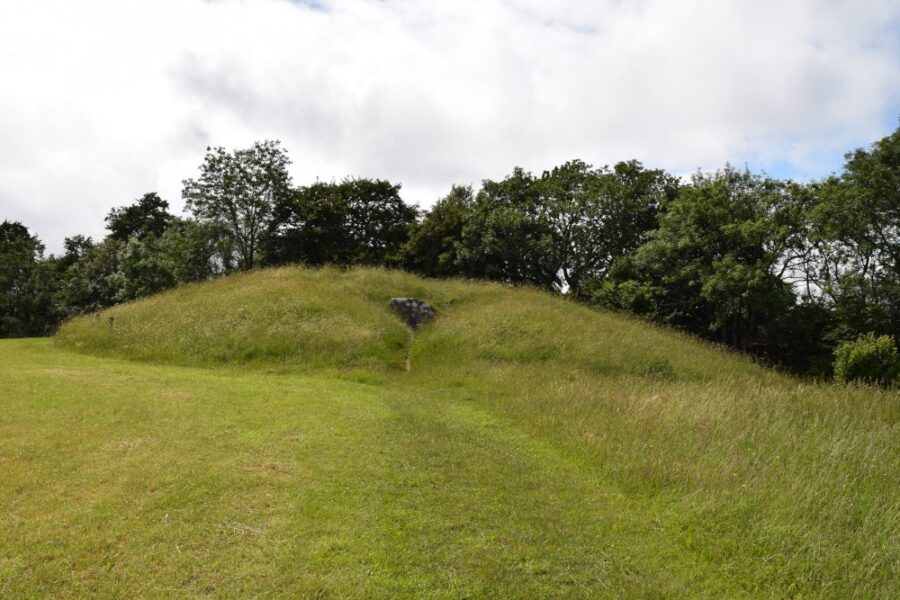
at Hetty Pegler’s Tump
It is the middle of May. We are talking about the jumbled bones, and who would be chosen to be put in this tomb, and why. Charitably speaking, it might have been members of the noble caste, as in an 18thC mausoleum, though some bones in barrows, apparently, bear the marks of assault – not that the two are incompatible of course. Perhaps they were martyrs, heroes, or sacrificial victims – again we may ask, what’s the difference?
Richard suggests they might be a deliberately varied selection, and maybe that’s why the bones are ‘dis-articulated’, jumbled up, not making sense. Another idea is that they were moved around, perhaps fairly regularly, in the tomb; moved further back perhaps, to make way for new ones: a ritual procedure, perhaps initiation, of going deep into the awful, unbearable smell, and sight, of decomposing bodies in dark, confined and airless little caves…..
Of course we talk about the aperture as being like a vulva: you come out (once again) if you’re one of the living; if one of the dead you’ve just gone back to whence you came: the female is ‘all-encompassing’. We talk of ‘natural religion’ – this is good. Is this place a product of a transitional phase between nomadism and settlement, and hence of the dawning of symbolism, symbolic culture coming about as humanity settles? Where we settle down we must have something to do with the dead, and they can be revisited, and be a sign to ourselves and to others. Boundary markers in a simply geographic sense won’t do, though here we are, we have to say, and here they are, our dead. And thus, this is our territory….
*
The spirits are tricksters and hence interfere with the would-be settled barrier between life and death, so maybe the so-called ‘fake’ entrances are not to fool the spirits but to admit them, at least acknowledge them, symbolically, the back door being where the real action, or interaction, most often is. (As in our old council house in Sedgley – the ‘front door’ more or less symbolic, like many people’s smart ‘front rooms’!)
*
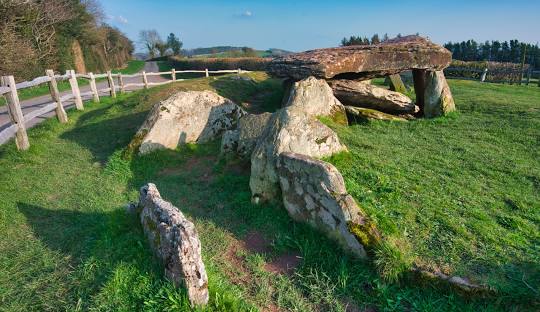
Later at Arthur’s Stone, near Dorstone – Ahh! The fake entrance is actually a kind of upright ceremonial slab – like a Front Door in inverted commas – which doesn’t even pretend to be openable or lead to anywhere….
*
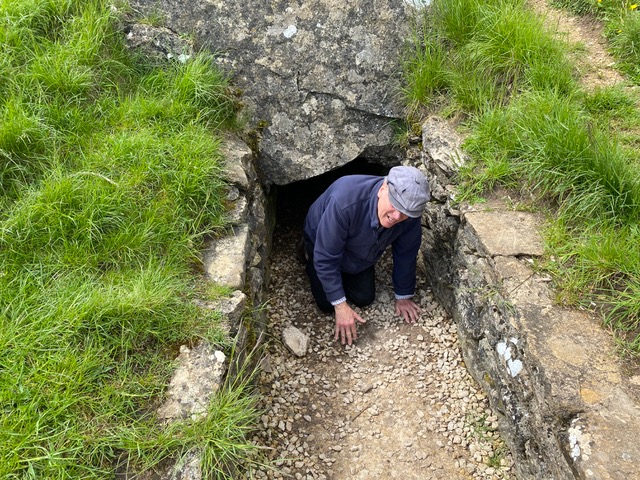
Crawling out of the Tump – with difficulty (!) and care, gathering patches of yellow-white earth on the knees of my trousers. Afterwards I joke in messages to friends,’It wasn’t that hard in 1952!” and Claire replies: “You were younger then!” But yes, I wonder, what does it do to your life if you know your birth was very hard? (‘Birth trauma’: remembered unconsciously in your bones and tissues….)
*
At the Church (Leonard Stanley)
R points out that the whole point about Adam & Eve is that they weren’t animals. (I wonder what the previous visitor, who told our local impromptu and friendly guide that it wasn’t actually Adam & Eve, actually thought they were?)
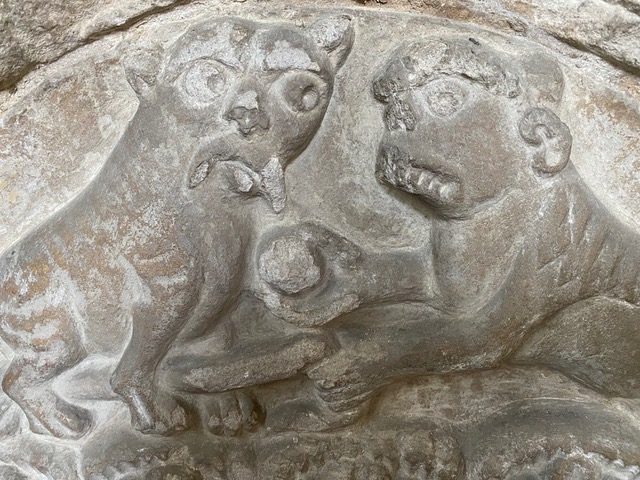
She is wild, and he looks scared, coerced. I think: she has both the Apple and the Snake (as Blake knew); she is the whole damn deal. What mere man isn’t terrified, knowing there is no choice, that birth and death are one, not two? Yes this is the thing, Mankind. “We come and go from women / into air”. And again, why Christianity can be seen as so much to do with the man problem – we may have our seed and our violence, but female is the world we come out of and go back to symbolically: the whole thing starts and ends and starts again over and over with her. She is the earth, and women are so clearly her servants. Now, we men can’t bear to hear that coming from her, so once we get settled, we need to protect the homestead and the tribe, which we do at all costs, and hence grow big ideas about ourselves, which may be called, in one result, the monotheisms. The job is to find a way to go beyond this, in fact to grow up into mercy, through the hard and constant work of reflexion, for ‘natural religion’ has got very complex and it can’t see what it is. Man can’t see what he is. Look, there is no apple with no serpent. And vice versa.
*
Sex and death are the same impulse, shown in the story of Orpheus and Eurydice. She is sent back (to death) because O cannot resist his wanting her, to look at her, look after her: his attachment. Love and death: you can’t have one, you can’t have one, you can’t have one, without the other. Yes, I know, it’s obvious.
But Lewis Hyde, in his fascinating book on the trickster writes: (perhaps) it was not doubt that moved him, but resentment. Who is she to have made him charm old Charon with song, and pacify that three-headed barking dog guarding the distant shore? Who is she that he let his art be drawn into this hopeless enterprise?
(Lewis Hyde: Trickster Makes This World)
*
The jumbled bones at Hetty’s: marks of violence / marks of honour – were people sacrificed to flit for our benefit between the kingdoms of life and death?
Transgressors of the Boundary.