(January 2022)
It is deepening Autumn now in the valley of Grwynefechan. I am walking the top road, looking down: the path is full of briars that have spread themselves all summer long, stretched limp across the tarmac. The road itself is falling away, I fume to myself, because of the heavy trucks from the building work at the farm at the top, that shouldn’t be even trying this road in the first place.
The other night I heard an anguished owl, disturbed, across the wood, and was reminded that this is all body, its stink, the sharpness of claws, the softness of organs. Whew.
I see sawn-off trunks that have fallen and crushed a fence, and very old stiles allowed to collapse. A bit like Dante (!), I’m walking the top road, looking down and thanking God that my addictions, so I suppose, are only coffee and poetry. Poetry, I tell myself! As if there’s some Virgil walking beside me. What do I know? The universe I make tonight is the lane, the breaking trees, the soft wet grass, the owl’s harsh song and the stars’ edges. It is my wounded breathing, my old friend’s cancer, some imaginary beautiful Beatrice.
This hell, this heaven, in which the star burns up, the yellow apple falls to the ground and rots: Paul up the road got Weill’s disease from well-fed rats; the stream is rocking with turbulence and nobody’s house is secure. Looking from the safety of my ledge, (I’m smiling at my pretension) hand in hand, with the ancient poets: Virgil, Arnaut Daniel, Dante, Eliot – ah the great male lineage! Knowing all and knowing nothing. What do we know, I think, of one another’s secrets and fixations, what do we know of our own? Ignorance may be bliss they say, but is no defence in court.
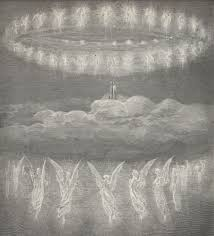
*
O’odham cosmology is based on an intersection between multiple vertical layers and a horizontal plane. The staying earth is where all humans, animals and the natural world exist. Farther west is the ocean (Gulf of California), an important site for prospective shamans as well as a salt-gathering location. Scattered over the horizontal plane are sacred mountains, caves, and shrines, where spirits and humans may interact.
The spirit of a deceased person can return from the si’alig weco to visit their descendants in the form of an owl (cukud). Such owl visitations are also a way for spirits to teach humans in the shamanic and curative arts. But deceased humans can also become spirits called devils (jejawul). An O’odham devil was a cowboy in life. Upon death the devil establishes residence in one or another of the devil mountains that dot the desert. Here the afterlife location is also idyllic in that the devil continues to do what he did in life – the cowboy job of riding horses, rounding up cattle, and so on. A third, and tragic type of human spirit is the devil-owl (jiawul-cukud). This person was a cowboy in life but one who died in some violent manner. Perhaps most common of these spirits are those who died in automobile accidents.
from: David Kozak & David Lopez: Devil Songs and Devil
Sickness: Tohono O’odham poetics
*
IMAGE OF LADY WITH BASKET HAT
*
Perhaps all culture is cosmology.‘Of the devil’s party…’ (as Blake said of Milton): no doubt the Inferno is the most ‘gripping’ and the most popular of the book of the Divine Comedy, being to do with fantasies of revenge and cruelty. Don’t we love all that. This is Dante’s cause, his heroism, to walk and look down on those he has judged and punished in poetry. We all have our causa sui, our self-cause, born of our need to assert ourselves in contradiction to others, and such is a function, when all’s said and done, of any of imagination’s worlds.
*
Even in hell, or especially so, it’s not like it’s actual death: in Christian and maybe all other cosmologies, death is imagined full of life! And idealised love is a corollary of this, of course..
A friend of mine says she found solace looking down into Inferno in the wake of her brother’s suicide. There is recognition there, solace, and not just the solace of schadenfreude, but of finding ourselves down there and that we are far from alone.
In Dante there are those who speak, and those who can’t.
BADLANDS PHOTO
*
So it’s late October in the valley and the stream is turbulent and leaves are all over the car; there are red wet leaves all over the lanes. I’ve been reading Dante’s fantasies: Virgil; Arnaut Daniel, il miglior fabbro, ‘the greater maker’ (as Eliot, quoting, said of Ezra Pound); Dante himself and Eliot – and we’re back to The Waste Land again. It’s been a century since it was written and it’s possible we may not get another really livable one. I read of Dante’s complex and crazy cosmology: funnels, terraces, spheres. I say to Lyn: I thought Christ came to bring His mercy to all, not condemnation. Aren’t they all supposed to be saved, at some point? And Lyn says, Well, that’s just the way it is. I thought, according to that myth, that it was Christ, and our own recognition of his great suffering and ours, that brings about Mercy, as in the Bodhisattva Vow that says I will not save myself from suffering until all beings are saved; that it’s not just the memory of some beautiful young woman that will lead us, no, lead him, the singular man, the artist, the greatest maker, up, up, to transcendence? But, there you are, I suppose: ‘the way it is’. That’s cosmology for you.
SAINT IMAGE
*
And what is beauty anyway? Witness the extraordinary cleverness and skills of the bower bird, constructing that incredible nest, singing those songs that can imitate human children playing in the distance of the forest, laying perspective pathways of gathered blue berries and feathers and bits of glass and rifle shells to impress a discerning mate. Or that goddess on the TV dance show, larger than life, with that beautiful, powerful face and hairdo, her dress, those eyebrows! It seems we’ve inherited beauty from nature’s excess. The Beautiful says: You see how I stand out! I’m prominent and still survive. I’m astonishing, colourful, gorgeously sculpted; I am superior, I am immune. Your genes are safe with me, and look, see how I’ve gone to all this trouble – for you!
*
The Sybil leaves her prophecies on leaves by the door of her cave – and when they get blown away, that’s just too bad, she’ll not repeat them. She offers Prophetic Books to the King; He refuses. Too bad, she says and does away with three of them. Now do you want them or not? No, go away, stop bothering me. So she destroys three more, and at last he relents. Now then, how much have we lost?
Maria Sabina, the Mazatec curer, said she could no longer work once her gifts had been ‘discovered’, brought out into the open by the West, once the celebrities had been and gone. The power will not work outside the cave.
The Sybil is its guardian; she lives in one and knows its hundred entrances into the Underworld. It’s easy to go down, she says, but not so easy, no, far from it, to return.
Virgil says she is a priestess, possessed by the God. But is that it? Is she not rather possessed by the Self, its chthonic voice? Compare Maria Sabina: when in her chant she becomes as if Christ and takes on other male roles like those of judgment, bureaucracy, law, she is not in obeisance to them: she takes them on, she becomes them; she takes back her Self.
Thus, do not chase after fame, poet, the legend says; such ambitions will just blow away like leaves in the wind! Like the wind in a horse’s ears. And if you don’t want the books, it will be your loss and danger, it won’t be hers.
*
IMAGE
Priestess = poet. She knows the way to the underworld, ie. the unconscious; she knows the secrets of death. She gives to Virgil the Golden Bough that grants him entrance. She knows how to get back out. And this is what men fear most, we know, and what the great City is built on, of course, what Culture is built on. Culture is Empire: all its great glories are built on a hollow cave.
Who will find the Sybil’s leaves? What stray passers-by may pick them up? I’m reminded of casting a poem in a bottle, out from a Scottish rock: who knows where the tide will take our secret words! The most unpredictable finder will perhaps be your most intimate audience! And our consolation is always: well you never know who just might read it somewhere, sometime, and be affected; like you never know what you might have said, or taught, that might somehow affect somebody’s life. You never know.
And similarly, how a poem might occur, and keep popping up, like The Waste Land now, again, with new significance and importance, deepened understanding. There is no fixed state to the poem in terms of how it is heard, by horses or not, or found, blown down a drab city street, or along a country road.
*
The Journey to the Underworld! The Hero’s Journey – today (23rd October and subsequent days) I enter the zone of creative connections, I enter the labyrinth! Of course, the Sybil of Cumae; The Golden Bough (which was Sybil’s); T.S Eliot’s personal Waste Land; his crises, especially those of his marriage, to do with his actual sexuality as much as his and society’s ignorance and fear of Viv’s body and mind. Ah men, who put her away, like Sybil was by Apollo, in a jar because he can’t have sex with her (let’s call a spade a spade) and, like men do, says: “Well, this is what you wanted isn’t it – a life as long as a handful of sandgrains? Have it then! Wither away in a prison, the prison of your untouchable body.” Is it any wonder that Eliot quotes Petronius in his epigram to the entirety of The Waste Land? Sybil, taunted by boys: “What is it you want?” “I want to die.” Did Viv say this to Eliot? It isn’t hard to imagine.
*
Of course you have to climb over Satan to get out of hell – you have to climb over war, rape, horror – and, according to the Christian myth, over death itself, which mankind created by coming to consciousness.
*
I’m amazed at this: that Mary Shelley claims, in the preface to her novel, The Last Man, that she found her story in the leaves of the Sybil. And that they told of the end of the world by the end of the 20thC.
Joseph Campbell writes of us living in a ‘terminal moraine’ of myths and mythic symbols.
Our bodies are drawn together by the gravitational pull of stories, and those stories are comprehensible and unfathomable (!) = poetic, in equal measure because of this mythos, which is buried, largely unrecognised and unnoticed, in the language, the tropes or dramas, the metaphors, and the conventions of story.
This the secret magic of the cave: all discourse in the public arena carries great hidden freights; and, at its depths, lies our mortality denial, birthing and conditioning all culture.
IMAGE
Please see Junction Box Dante special